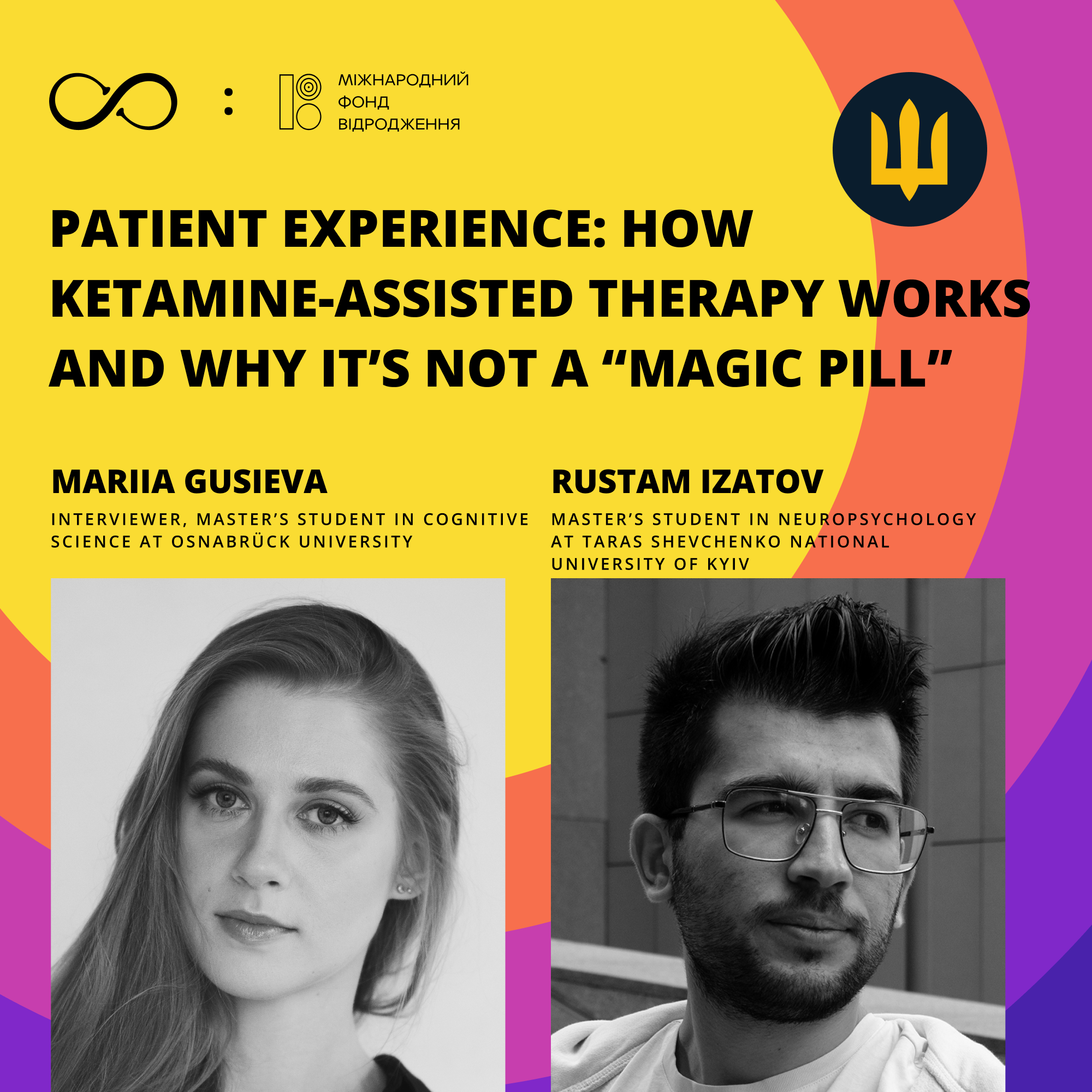
PATIENT EXPERIENCE: HOW KETAMINE-ASSISTED THERAPY WORKS AND WHY IT'S NOT A “MAGIC PILL”
-
Mariia Gusieva, Master's student in Cognitive Science at Osnabrück University
-
Rustam Izatov, Master's student in Neuropsychology at Taras Shevchenko National University of Kyiv
“For me, KAT is about self-discovery, and from a practical standpoint, it has an undeniable antidepressant effect... Ketamine ‘unlocks’ and brings together memories, thoughts, and emotions that the brain normally suppresses.”
I went to a psychotherapist for about a year. The therapy included CBT, Gestalt therapy, and some techniques from schema therapy, where we revisited traumatic memories and changed the scenarios. The therapy definitely had an effect. If you compare me before and after therapy, I’m basically two different people.
I first heard about KAT (ketamine-assisted therapy) from a classmate who underwent this therapy regularly. She said that it results in the growth of dendrites (note: the extensions of neurons that transmit nerve impulses). But I didn’t decide to try KAT right away. As it turned out, 2025 and 2026 were very stressful years for me. But since I already knew that ketamine therapy is capable of, let’s say, restoring the brain and nervous system, and also has an antidepressant effect, I decided to give it a try.
Eight. I paid for four sessions myself, and attended the other four as a study participant. Also, after every other ketamine infusion, I had an integration session with a psychotherapist to process the experience.
After the first session, I could already feel an initial antidepressant effect, and after the second or third session, this effect intensified even further, accompanied by an aftereffect in the form of improved cognitive abilities.
Because I wanted to gain a deeper understanding of the reasons behind my condition, to look within myself, into the recesses of my mind.
They’re definitely different. When you go through KAT, you have to actively identify the insights and realizations that come to you during the session, integrate them into your daily life, and notice positive changes. That’s exactly why integration sessions with a psychotherapist are so important. For me, KAT is about self-discovery, and from a practical standpoint, it has an undeniable antidepressant effect. Classical psychotherapy, in my opinion, is more straightforward: it can be put into practice more quickly.
There wasn't any at all. A classmate had given me a rough idea of what to expect beforehand. On top of that, I read up on the material on my own and mentally prepared myself for the session. I was mostly driven by curiosity and a desire to give it a try.
I experimented with self-medication a long time ago: I took dietary supplements to treat my ADHD (note: attention-deficit/hyperactivity disorder), as well as adaptogenic mushrooms such as the fly agaric and the Lion's Mane mushroom. And then I tried psilocybin. The first time, I didn’t feel anything—probably because the dose was too small—and later I tried MDMA. But my self-medication experiment turned out to be a failure, after which I realized it would be better to see a doctor. Overall, I realize that experimenting with substances carries risks and that, in principle, I could have done without such experiments. I advise other people to consult specialists right away.
First, there’s always an initial consultation to assess your condition, determine the appropriateness of this therapy, and discuss your needs. At the same time, you get to know the therapist. Immediately before the ketamine infusion (note: administration of the substance), you enter a specially equipped room, lie down on a special mattress that feels as if it’s filled with water, and are fitted with a sleep mask. After that, you’re covered with a blanket, music is turned on, and you’re connected to an IV drip containing a ketamine solution. Throughout the session, a psychotherapist remains by your side, waiting for you to enter an altered state of consciousness. When this happens, you and the doctor begin to communicate and interact. I’d like to note that the specifics of the procedure may vary slightly from clinic to clinic.
“Throughout the session, a psychotherapist remains by your side, waiting for you to enter an altered state of consciousness. When this happens, you and the doctor begin to communicate and interact.”
The psychotherapist would guide me when it was necessary to work through certain memories, asking questions designed to shed more light on a particular situation. Once, during a session, I had some very vivid images. During that session, the psychotherapist filled several sheets of A4 paper, and then, during an integration session, we discussed and worked through it all together.
It has never happened. Ketamine is a fairly stable substance when used in clinical settings, unlike recreational use. If ketamine is administered gradually via an IV drip, the risk of a “bad trip” (note: a negative psychedelic experience) is minimal. The course of a psychedelic experience is influenced by individual physiological factors, but “set” and “setting” (note: location and circumstances) play a very important role. But even during my personal experiments with, for example, psilocybin, when my mood was low, the psychedelic experience was still positive.
I was surprised by the sensation of my consciousness separating from my body. It’s as if the brain briefly disconnects from the constant stream of information coming from the body. During the first session, thoughts popped into my head: “Wow, where am I? What’s happening to me?” But these sensations had a positive tone—it was a new experience. It was also unexpected that ketamine “loosens your tongue.” You start talking, and the inner critic that usually controls you shuts off. And, of course, I didn’t expect an antidepressant effect after just the first session. By the way, the images that come to mind aren’t like hallucinations or ordinary rumination, when we imagine certain events or things. During the session, everything happens much more vividly and dynamically.
It was a cool, pleasant feeling, but I wouldn't call it euphoria. I'd describe it more as a chance to forget all my problems—a form of hedonistic escapism. But I don't feel the urge to repeat the ketamine experience just for that effect.
It’s actually hard to say. But there was definitely an effect. The outcome depends on a number of individual characteristics and circumstances specific to each patient. For example, my anxiety has decreased, but it hasn’t gone away completely, and I still haven’t resolved my sleep problems, even with the help of KAT. This may have affected how long the effect lasted.
First, I’d recommend sitting down and reading up on it—maybe watching some videos that explain the process of psychedelic-assisted therapy. Also, don’t expect immediate results or a full recovery after the first session. And you need to be prepared for unusual sensations and an unfamiliar experience.
Dissociation. Because that’s exactly what it is. You stop feeling your body the way you normally do. Or, to put it simply, it’s a “stream of consciousness.” Ketamine “unlocks” and brings together memories, thoughts, and emotions that the brain normally suppresses, and as a result, insights emerge.
“Dissociation. Because that’s exactly what it is. You stop feeling your body the way you normally do. Or, to put it simply, it’s a ‘stream of consciousness’.”
Rustam’s experience shows that ketamine-assisted therapy is not an instant solution to all problems. For some, it can be a way to better understand themselves; for others, it can serve as a complement to existing treatment. In any case, as Rustam emphasizes, KAT does not eliminate the need to work on oneself, but it can open up new possibilities for that work.